Teaching in Peru
In Peru, there is an urgent need for English teachers, especially in Lima, Peru's capital. The numbers of available positions is abundant. Bigger companies have in-house instruction, but most people have to arrange their own lessons privately. Based on what previous experienced teachers have recorded, one must be careful about perks and salaries that are promised by some employers and not actually delivered. Salaries generally are $5 USD per hour or $800 USD a month working full time in an institution; private lessons are $10 USD per hour. Cost of living is very low so depending upon how much the teacher wants to work will depend on how well he or she will do financially. There is an array of possibilities. You can choose the age groups and settings that would be best suitable. Lima may have positions for those who want to just teach in a business setting, public schools and language institutions. If you are interested in teaching in remote areas there are even ecotourism positions that may be available. The smaller metropolis of Cuzco, for instance, may offer positions from primary aged children to specialized adult learner classes. Some schools may offer furnished accommodations. Local people are considered to be very helpful to the foreigner who seeks a place to stay so you do not have to worry too much and can make plans as you go along.
Travelling in Peru
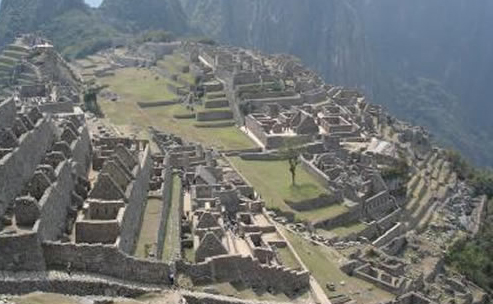
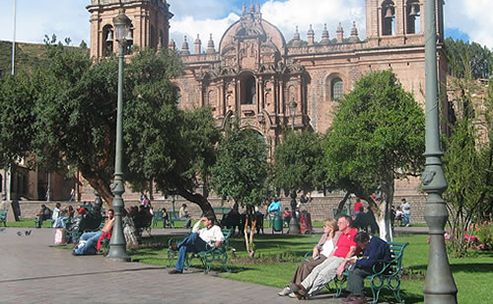
Peru is a country of contrast, with a glorious past and promising future. Peruvians are proud nationalist who are always willing to talk to foreigners about their Inca heritage and crown position for the Spanish Empire in South America during the European expansion into the American continent. Cities like Cusco are torn between two cultures but at the same time live harmoniously one next to the other. For example, you can view the massive "Plaza de Armas" and Government Palace just a couple of feet away from former Incan temple and a little further down the Inca trail; the great Macchu Picchu.
Unlike other equatorial countries, Peru does not have an exclusively tropical climate; the influence of the Andes and the Humboldt Current cause great climatic diversity within the country. The coast has moderate temperatures, low precipitations, and high humidity, except for its warmer, wetter northern reaches. In the mountains, rain is frequent during summer, and temperature and humidity diminish with altitude up to the frozen peaks of the Andes. The jungle is characterized by heavy rainfall and high temperatures, except for its southernmost part, which has cold winters and seasonal rainfall. Because of its varied geography and climate, Peru has a high biodiversity with 21,462 species of plants and animals reported as of 2003; 5,855 of them endemic. The Peruvian government has established several protected areas for their preservation.
Main Attractions
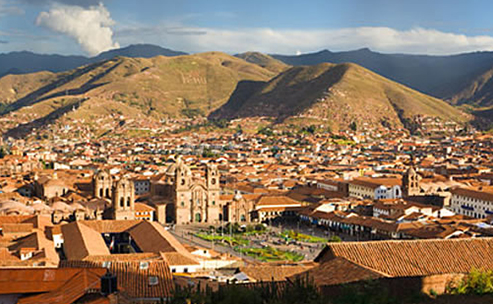
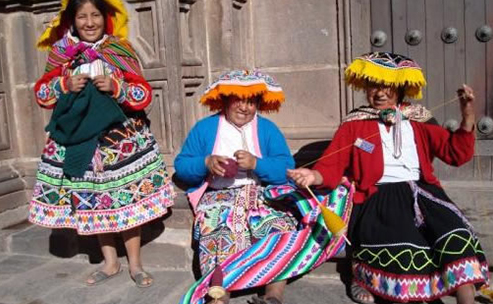
Some of the most important sites to visit in Peru are Macchu Picchu, Cusco, Cajamarca, Huaraz, Ayacuco, Puno, and many more locations. These locations in Peru hold some of the country's largest cultural treasures and breathtaking scenery. The capital of the Inca Empire (founded AD 1100), Cusco today is a fascinating mix of Inca and colonial Spanish architecture and was declared a World Heritage Site by UNESCO in 1983. Almost every central street has remains of Inca walls, arches and doorways that serve as the foundation for the colonial and modern buildings. More archaeological sites are abundant in the nearby area and towns. Narrow alleys of whitewashed houses with sky-blue and bottle-green shutters open out onto elegant squares with stone-hewn fountains and elegant restaurants and posadas (inns). Colorful murals depicting historical scenes can be seen on countless walls and indigenous women with braids and embroidered shawls set up makeshift stalls selling woven blankets and handmade crafts and jewelry. Shops around the main square are open all week from dawn to midnight, but close for about two hours during lunch.
Activities
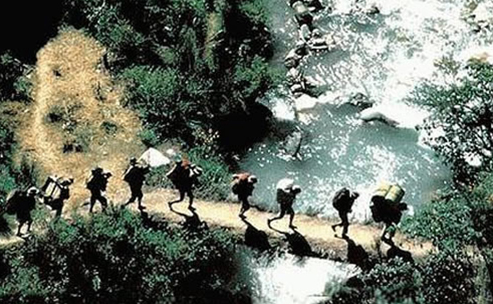
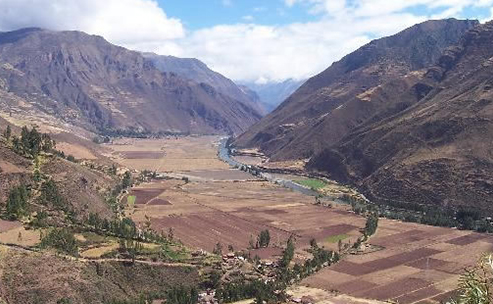
There are a great number of activities to do while you are in Peru. In Cusco, you can always take a weekend on the Inca Trail which is a walking route that leads through the mountains above the Urubamba river, following (at least partly) the course of an old Inca roadway leading to the city of Machu Picchu. Hiking, trekking, mountain biking and many more activities can be done during an afternoon or any weekday morning.
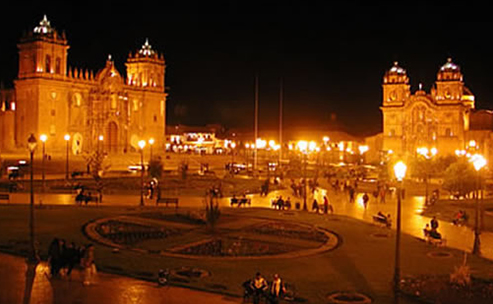
For those who are less physically active or not that fond of the great outdoors there is always touring the city of Cusco itself. Cusco is very similar to San Francisco in terms of down and uphill streets which make taking a walk to work every day a full cardio workout, but it is worth every drop of sweat. Places like the Plaza de Armas provide you with an excellent atmosphere to simply sit down on one of the many benches throughout the square to see the people walk by and enjoy a strong Peruvian coffee blend.
Transportation
Inside Cusco, there is usually no problem getting around on city buses or taxis. Buses cost between 0.70 and 1.50 Soles (USD $0.20 - 0.40), taxis between 7 and 8 soles (USD $2.00 - 2.40). "Taxi" does not necessarily mean a car; the term also refers to bicycles, motor rickshaws, and motor bikes for hire. Taxis are divided between "formal" taxis, painted and marked as such that have a sticker with SOAT, and informal ones, that are just cars with a windshield sticker that says "Taxi". The last ones are better left to the locals, especially if you don't speak Spanish. Apart from the more upscale radio taxi (also the more expensive ones), the fare is not fixed or metered, but it is negotiated with the driver before getting into the vehicle. There is no tipping at taxis.
Festivals
- Lord of Tremors: A festival that celebrates the merge of Peruvian and Christian religions. It honors the traditional idea that in 1650 a Christ of the Good Death stopped an earthquake that threatened to level Cusco. The Lord of Tremors festival is held in the last week of March and the first week of April.
- Cusco Beer Festival: This festival is a huge draw. It's been in late May, sometimes June, and people travel to Cusco from all over to be part of the Beer Festival. Musicians play live music throughout the afternoon and night. The Beer Festival gets pretty crowded, due to its popularity.
- Corpus Christi: The Cusco festival of Corpus Christi is the most impressive in all of Peru. A processional of saints and virgins from all over the region meet up in Cusco and come together in the main cathedral, late in the morning. There, they ceremonially "greet" the risen Christ. The Plaza de Armas is very, very festive and crowded at this time, with a lot of traditional food, bread, and beer to be consumed. Corpus Christi in Cusco is held two months after Easter Sunday, sometime in June.
- Inti Raymi: This festival, the Inca Festival of the Sun, dates back to the Inca Empire as a celebration of the Sun God. The vivid colors Peruvians wear throughout the procession, contrast stunningly with the greyish rocks of the buildings and ruins. This is, in many opinions, the most visually beautiful of all the Andean festivals. The Inca Festival of the Sun is held on June 24 or the Winter Solstice in the Southern hemisphere.
- Christmas in Cusco: Christmas in Peru combines elements of Inca, Andean and Christian traditions and religions. The Christian missionaries allowed this, to make Christianity seem more palatable to the Inca people; many gods were merged into one or renamed as Christian saints. Today, Christmas in Cusco has these merged traditions, seen by the nativity scenes in front yards and churches. Christmas in Cusco is held December 24-25, ending with Santuranticuy; the sale of the saints.
Cuisine
Peruvian cuisine is among the most varied in the world. Not only does the country grow a variety of fruits and vegetables, but it does so throughout the year. Peruvian geography offers at least 8 different climates (desert along the coast, steep and high mountains, the Amazon basin, etc.). In Lima, due to its history as an important Spanish colonial port, the dishes are a mixture of Amerindian, Spaniard, African, Asian and even Italian influences that contribute to the ever changing "platos criollos" (creole dishes). Rice is the staple foodstuff; expect many dishes to include rice, in the mountians, like in Cusco, its corn and potatoes, and in the Jungle yuca. Meat is traditionally included in most Peruvian dishes. Chicken, pork, sheep and beef are common. Alpacas are actually kept for wool, not for meat. Mostly, you will find that alpaca meat is rather tough. An Andean delicacy is guinea pig. Peruvian cuisine includes dishes which use various organs, including anticuchos, a kebab made from very marinated and spicy beef heart, and cau-cau, made from cow stomach served in a yellow sauce with potatoes. Anticuchos are a standard street stall food, but be careful with it because it can make a foreign stomach sick.
Money and Living Expenses
The currency of Peru is Nuevo Sol. 6.18 Sols is equal to 1 pound and 3.23 Soles amounts to 1 USD. The minimum monthly salary in Peru is $155. $500 monthly wage allows a person to live comfortably in Peru. Teachers get the highest wage in this country. A degree in English can easily fetch a salary of $600 per month in the language institutes of Peru.
Living in Peru can be cheap if certain budget plans are followed. To make a cheap living in Peru it is advised that people opt for home-cooked food. A 3-course meal in an ordinary restaurant can cost as much as $8 whereas a medium-sized pizza costs about $10. It is cheaper to buy the groceries and cook food at home. Apartment rentals in Cusco can go for as low as $200 USD a month.
Phones & Communication
In all towns and villages that are not too small, it is no problem to find public telephones for national and international calls. Usually, you find them in bars or stores. Some of them accept coins, but watch out for stuck coins or dodgy-looking coin receivers as these might make you lose your money. Don't worry if your 1 Nuevo Sol coins don't get through at first, just keep trying and it will eventually work. Many public phones can be expensive, and an attractive alternative is a Locutorio, or "call-center". Typical rates include 0.2 Nuevo Sol a minute for calls in the country, and 0.5 Nuevo Sol a minute for most international calls.
You can also buy phone cards with a 12 digit secret number on it, using a phone card, first dial 147. When done so, you will be told how much your card is still valid and be asked (in Spanish, of course) for your secret number. After having typed it, you are asked for the phone number you want to connect to. Type it in. Then you get told how much time you can talk. After that, the connection is tried.
For international calls, it is often a good idea to go to an Internet cafe that offers Internet based phone calls. You find them in the cities. Internet cafes, called in Peru cabinas públicas, grow like mushrooms in Peru and if you are not really on the countryside, it should not be a problem at all to find one. Even in a smaller town like Mancora or Chivay you can still find Internet cafes with 512kbps ADSL. The connection is quite reliable and they are cheap (1.50 - 3.00 Soles, USD $0.40 - 0.80 per hour). Just don't expect most of them to actually sell coffee - or anything at all but computer time or services like printing. It is not uncommon to find cabinas that burn CDs directly from SD, CF or Memory sticks. Many internet cafes have headphones and microphones for free or for an extra fee.
Electricity
Electricity in Peru is 220 Volts, alternating at 60 cycles per second. If you travel to Peru with a device that does not accept 220 Volts at 60 Hertz, you will need a voltage converter. Power outlets are for two flat blades or round pins.



 ITTO School's Map
 Guadalajara
.jpg)
.jpg)
.jpg)
.jpg)
.jpg)
.jpg)
.jpg)
.jpg)
.jpg)
.jpg)
.jpg)
.jpg)
.jpg)
.jpg)
.jpg)
.jpg)
.jpg)
.jpg)